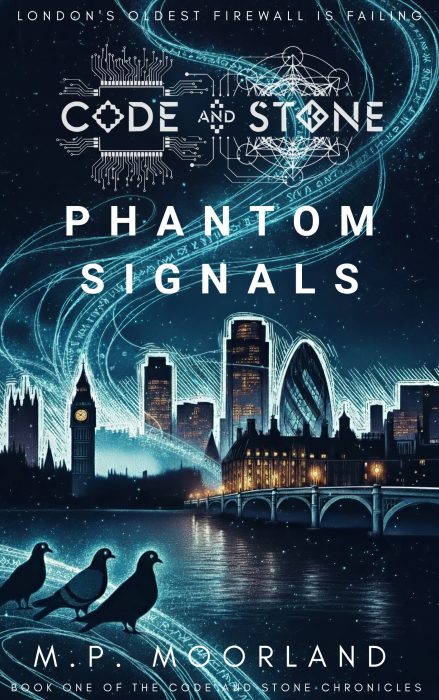
Fantasy heroes often arrive pre-packaged.
Detectives with impossible instincts. Ex-soldiers with mysterious pasts. Secret heirs to ancient bloodlines. Or they’re twenty-two years old and haven’t yet discovered they’re the most important person in the kingdom, which they definitely are, because it’s that kind of book.
My protagonist Stephen Harris isn’t any of those things.
He’s forty-five. Divorced. Exhausted. He works in IT. His biggest concern at the start of the story is his train being late and whether the coffee was really worth nearly five quid. (It wasn’t. It’s never worth five quid.)
That wasn’t an accident.
The People Nobody Writes About
There’s a reason I chose an IT contractor specifically, rather than any other ordinary profession.
Competence isn’t always loud.
The people who quietly keep organisations running rarely make the headlines. Nobody writes articles about the engineer who quietly stopped the network falling over on a Tuesday afternoon. They only notice when the engineer isn’t there.
Those are the people I find interesting. The ones who solve difficult problems because somebody has to, not because they think they’re the hero of anything.
The Problem With Interesting Problems
I’ve worked in IT for a long time, and one thing I’ve learned is that interesting problems don’t announce themselves with explosions or dramatic music.
They start with something small.
A log entry that looks slightly wrong. A server behaving differently from yesterday. A user insisting it only happens at 10:14 on Thursdays, in a tone that suggests they’ve been dismissed about this before.
Everyone else ignores it because the system is still technically working. The good engineers don’t. They make a note. They start quietly asking questions. They get home two hours late because they couldn’t leave it alone, which their partners will confirm is less charming in practice than it sounds in theory.
A Skill Nobody Asks For
Stephen’s first useful skill has nothing to do with the supernatural.
He notices patterns. He spots anomalies. He has the slightly irritating quality — familiar to anyone who’s worked with good engineers, or been one — of treating “it’s probably fine” as a provocation rather than a conclusion.
That mindset felt more interesting to me than giving him a magical sword. Anyone can swing a sword. Not everyone will stay up until two in the morning cross-referencing logs because something felt off.
Starting From Somewhere Worse Than Zero
Stephen also isn’t starting from a good place.
His marriage failed. A project he poured years into fell apart. His confidence has quietly evaporated — not dramatically, not all at once, but in the way confidence usually does. One compromise. One disappointment. One bad year at a time.
So he does what a lot of people do after life kicks you in the teeth in quick succession. He makes himself smaller. Takes safer work. Keeps his head down. Stops expecting much.
I think more people recognise that person than we’d like to admit. Certainly more than we recognise the secret heir to the ancient bloodline in themselves.
The Problem With Being Forty-Five
One of the reasons I wanted Stephen to be in his forties is that life has already happened to him.
He carries regrets. He knows what failure feels like from the inside. He has enough experience to know that being clever doesn’t stop you from making spectacular mistakes — if anything, it just makes the mistakes more elaborate.
Every decision costs him something. He’s not chasing adventure. He’s actively trying to avoid it.
Unfortunately for Stephen, reality has other ideas. Reality is not especially interested in what Stephen would prefer.
Debugging the Impossible
As the story unfolds, Stephen faces things that shouldn’t exist.
His first instinct isn’t to fight them. It’s to understand them. Why is this happening? What’s the pattern? What am I missing?
The same questions he’s been asking his entire career. The difference is that this time, the system he’s debugging appears to be reality itself.
That, and reality has never tried to eat anyone. As far as he knows.
The Hero Nobody Ordered
I’ve become less interested in characters who already know they’re destined for greatness.
I’m far more interested in people who’ve quietly concluded their best years are probably behind them and then turn out to be wrong about that, at considerable personal inconvenience.
There’s also a selfish reason. I’m in my fifties now. Most of the genuinely capable people I know aren’t twenty-two. They’re carrying mortgages, bad backs, complicated histories, and enough experience to know exactly how badly things can go wrong. They’re still quietly solving impossible problems every day. Fantasy doesn’t always leave much room for those people. I wanted to.
Stephen isn’t fearless. He gets things wrong. He panics. He doubts himself at every available opportunity and at several unavailable ones. He’d hand responsibility to someone else in a heartbeat if anyone even remotely qualified turned up.
They don’t. He keeps going anyway.
Besides, if London really did need saving, I’d trust the exhausted IT contractor asking awkward questions long before I’d trust anyone with a magical sword.